
Page 1 of 6

THE UNITED REPUBLIC OF TANZANIA
NATIONAL EXAMINATIONS COUNCIL
ADVANCED CERTIFICATE OF SECONDARY EDUCATION
EXAMINATIONS
131/1 PHYSICS 1
(For Both School and Private Candidates)
Duration: 3 Hours Year: 2025
Instructions
- This paper consists of sections A and B with a total of ten (10) questions
- Answer all questions in section A and choose two (2) questions from section B.
- Marks for each question or part thereof are indicated.
- Mathematics tables and non-programmable calculators may be used.
- All writing must be in black or blue ink except for drawings which must be in pencil
- Communication devices and any unauthorised materials are not allowed in the examination room.
- Write your Examination Number on every page of your answer booklet(s).
- The following information may be useful:
- Acceleration due to gravity, g = 9.8 m/s2
- Gravitational constant, G = 6.67 x 10⁻¹¹ Nm2kg-2
- Mass of earth, ME = 6.0 x 1024 kg
- Radius of earth, RE = 6.4 x 10⁶ m
- Distance of the moon from the earth, r = 3.8 x 10⁵ km
- Density of water at 250C = 1000 kgm-3
- Specific heat capacity of water is 4200 Jkg-1K-1
- Density of ice = 1 g/cm3
- Thermal conductivity of ice = 0.005 cal/sec.cm o C
- Latent heat of ice = 80 cal/g
- Pie, π = 3.14
Page 2 of 6
SECTION A (70 Marks)
Answer all questions from this section.
- (a) (i) Explain why every measuring instrument has its limit of precision.
(ii) Determine the dimensional formula of torque and apply it to obtain the dimension of viscosity using the equation , where other symbols carry their usual meaning.
(b) Find the maximum percentage error in the measurement of specific gravity given that a stone weigh (5.0 ± 0.1) kg in air and (4.0 ± 0.1) kg when totally immersed in water.
- (a) (i) Explain the origins of tangential and centripetal acceleration in the
motion of an object along a circular path.
(ii) Determine the magnitude and direction of the net acceleration of a cyclist moving at a speed of 72 km/h, decelerating at a rate of 5 m/s² along a 100-m-radius circular path.
(b) The aircraft was horizontally flying at a height of 4,500 m above the ground and subtended an angle of 60° on the ground at two positions that were 10 s apart. Deduce the aircraft’s speed.
- (a) (i) Identify and explain the factors affecting the motion of oscillating
systems in Simple Harmonic Motion (SHM).
(ii) Write an expression for the displacement equation of an object executing SHM with an amplitude of 0.12 m and a period of 0.5 seconds.
(b) Use an appropriate sketch to describe the relationship between mechanical energy (kinetic and potential energy) with displacement.
Page 3 of 6
- (a) (i) Apply the concepts and principles of rotational motion to describe the
behaviour of rigid bodies in the absence of external torque.
(ii) Use mathematics to derive the work done by torque.
(b) Use mathematics skills to determine the angular acceleration of a disc which is rotating freely about an axis through its centre.
- (a) Explain briefly the following observations:
(i) Thermos flasks are designed to maintain the temperature of their contents for a long time.
(ii) Chairs made of metallic materials appear colder than wooden chairs during the cold season
(iii) Transformers are always kept in a tank containing oil.
(b) Calculate the new volume of the gas if an ideal gas of volume 500 cm3 at
300 K expands adiabatically and its temperature falls to 270 K when the ratio of their heat capacities is 1.4.
- (a) (i) Why does a good absorber of radiant energy appear black?
(ii) Give four information obtained from the curves regarding black body radiation.
(b) Calculate the energy radiated in one minute by a black body of surface area
200 cm2 maintained at 127 °C.
Page 4 of 6
- (a)(i) Distinguish between greenhouse effect and global warming
(ii) Enumerate four human activities which contribute to global warming.
(b) (i) Identify and analyse two warning signs which predict the occurrence of an earthquake and
(ii) Identify one key importance of the troposphere and stratosphere to humankind.
SECTION B (30 Marks)
Answer any two (2) questions from this section.
- (a) load resistor of 25 Ω is connected in series with an inductor of inductance
0.4 H and internal resistance of 5 Ω. If the pair is then connected across a
200 V r.m.s supply alternating at Hz;
(i) Draw a well-labelled circuit diagram for the connection and
(ii) calculate the r.m.s current value.
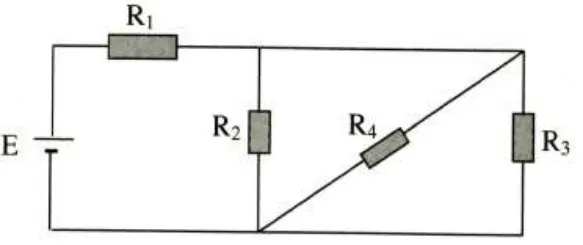
(b) You are provided with a circuit diagram as shown in diagram 3.
Diagram 3
Using the circuit diagram, the candidates were required to calculate:
(i) The equivalent resistance of the network and
(ii) The current passing through R2 = 50 Ω
Page 5 of 6
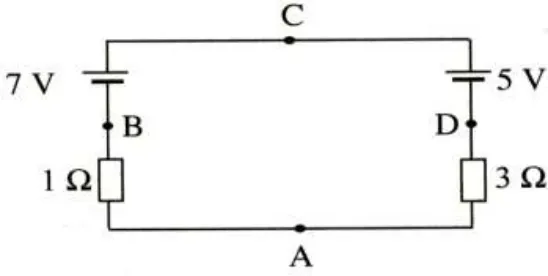
(c) Study the circuit diagram 4 and answer the questions that follow:
Diagram 4
(i) Apply Kirchhoff’s laws to find the potential difference between A and C.
(ii) Why does the potential decreases from point A to B?
- (a) (i) Give the necessary condition for a transistor to act as an open switch
(ii) Study the given electronic circuit and find the voltage across the capacitor, C.
(b) (i) Identify two characteristics of an op-amp.
(ii) Evaluate the output voltage VO in a given electronic circuit.
(c) (i) Give two advantages of using integrated circuits in electronic devices .
(ii) Briefly explain the mode of operation of a p-n junction.
- (a) In each of the following diagrams, find the truth table and mention which
single gate it represents.
(i)
(ii)
Page 6 of 6
(b) (i) What is meant by the voltage follower? Give one importance of it.
(ii) Point out three factors to consider when designing a voltage amplifier.
(c) (i) Sketch the labelled graphs of input and output characteristics of a common base transistor connection,
(ii) Determine the base current in an n-p-n transistor of collector current 10 mA if 90% of electrons emitted from the emitter reach the collector.